
All About Product Requirement Document (PRD)
A Product Requirement Document (PRD) serves as a blueprint for product development, outlining the functional and non-functional requirements, user needs, and project constraints.

Abstract
A Product Requirement Document (PRD) serves as a blueprint for product development, outlining the functional and non-functional requirements, user needs, and project constraints. This research paper delves into the structure, purpose, and critical elements of a PRD, offering insights into best practices and methodologies for creating effective PRDs. The analysis is grounded in a review of existing literature and practical examples, providing a thorough understanding of the PRD's role in successful product management.
1. Introduction
A Product Requirement Document (PRD) is a vital tool in the product development lifecycle, ensuring that all stakeholders have a clear understanding of the product's goals, features, and specifications. This paper explores the significance of PRDs, their components, and their impact on product success.
2. Purpose of a PRD
The primary purpose of a PRD is to:
Align the product vision among stakeholders.
Define the scope and requirements of the product.
Serve as a reference point throughout the product development process.
Facilitate communication between cross-functional teams.
3. Structure of a PRD
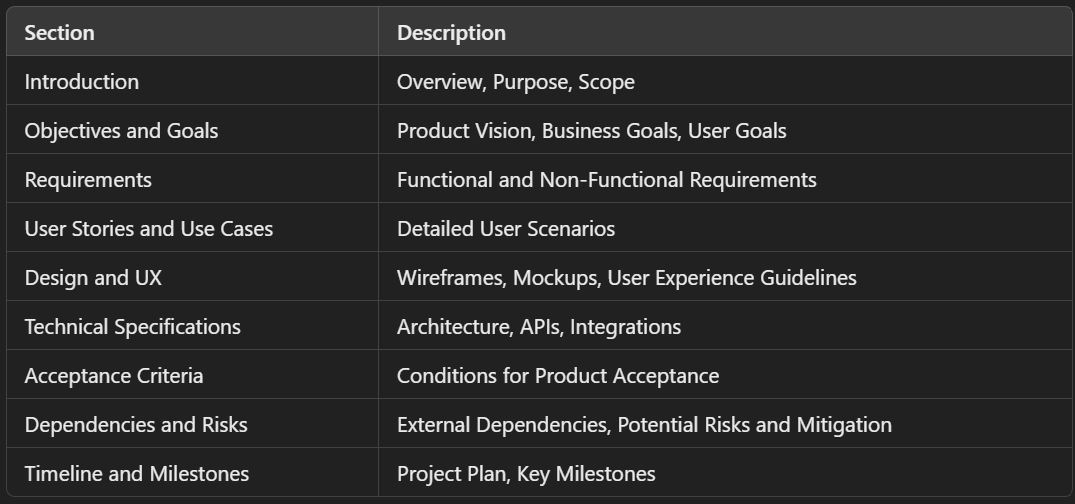
A well-structured PRD typically includes the following sections:
Introduction
Overview: Brief description of the product.
Purpose: The reason for the document and its intended audience.
Scope: What the document covers and what it does not.
Objectives and Goals
Product Vision: High-level view of what the product aims to achieve.
Business Goals: How the product aligns with the company's strategic objectives.
User Goals: What users are expected to achieve using the product.
Requirements
Functional Requirements: Specific behaviors and functions of the product.
Non-Functional Requirements: Performance, security, usability, and other quality attributes.
User Stories and Use Cases
Detailed scenarios depicting how users will interact with the product.
Design and UX
Wireframes and Mockups: Visual representations of the user interface.
User Experience Considerations: Guidelines for ensuring a positive user experience.
Technical Specifications
Architecture: High-level architecture and components.
APIs and Integrations: Required external interfaces and integrations.
Acceptance Criteria
Conditions that must be met for the product to be accepted.
Dependencies and Risks
Dependencies: External factors that the project relies on.
Risks: Potential obstacles and mitigation strategies.
Timeline and Milestones
Project Plan: Key phases and deliverables.
Milestones: Significant checkpoints in the project timeline.
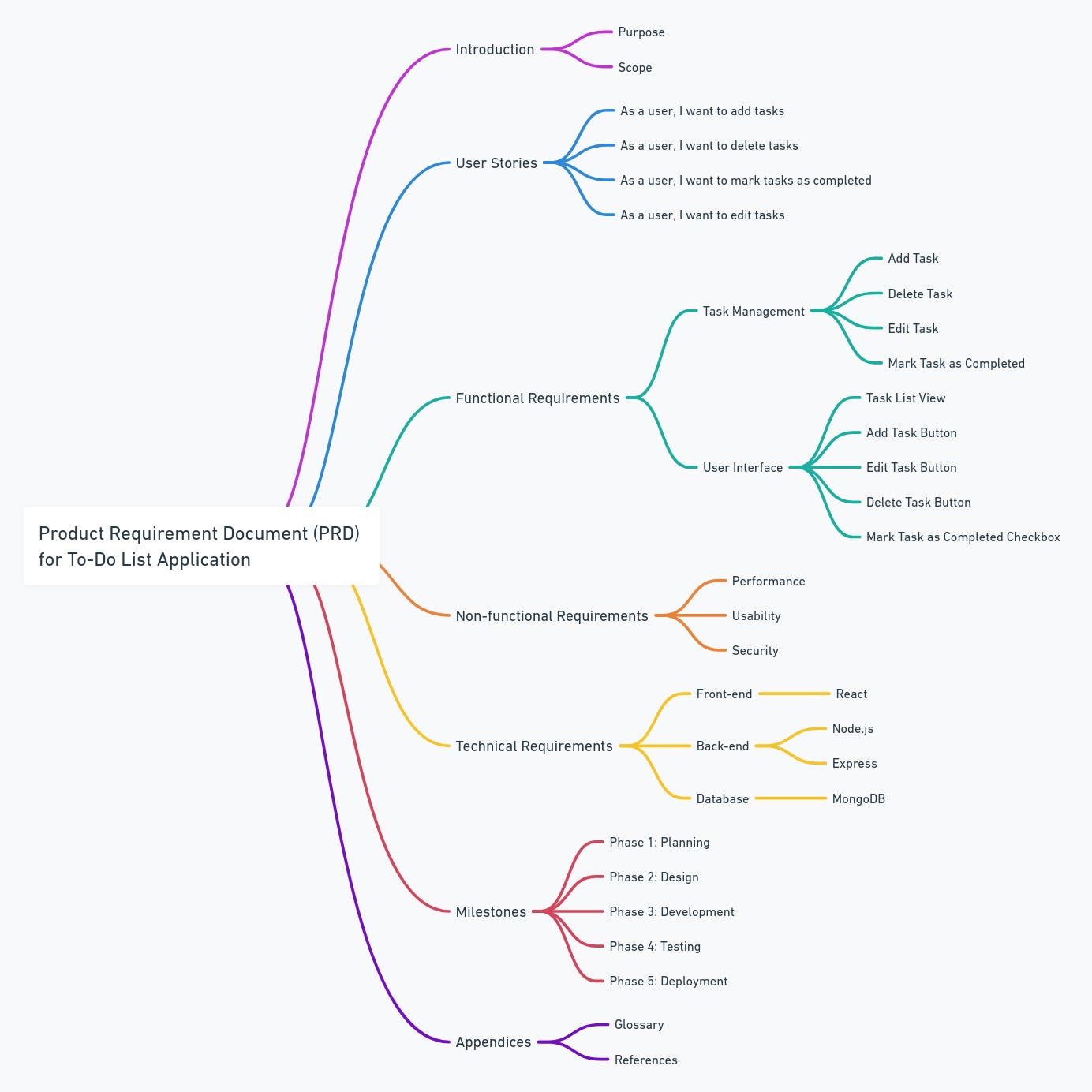
MindMap of PRD for a To-Do List Application
4. Best Practices in PRD Development
Collaborative Creation: Engage stakeholders from various departments to ensure a comprehensive and accurate PRD.
Clear and Concise Language: Avoid ambiguity by using precise and straightforward language.
Regular Updates: Maintain the PRD as a living document, updating it as the project evolves.
Prioritization: Clearly prioritize features and requirements to manage scope and focus on critical elements.
5. Methodologies for PRD Creation
Agile Methodology: Incorporating iterative development and regular feedback to refine the PRD.
Waterfall Methodology: A linear and structured approach, suitable for projects with well-defined requirements.
Lean Methodology: Emphasizing minimalism and efficiency, focusing on delivering value with minimal waste.
6. Impact of PRDs on Product Success
Effective PRDs contribute to:
Improved Communication: Clear guidelines facilitate better communication among team members.
Enhanced Planning: Detailed requirements aid in accurate project planning and resource allocation.
Reduced Risks: Identifying potential issues early helps in mitigating risks.
Higher Quality Products: Comprehensive requirements ensure that the final product meets user needs and business goals.
7. Case Studies and Examples
Analyzing real-world examples of successful PRDs can provide practical insights and lessons learned. For instance, examining PRDs from tech giants like Google and Amazon can reveal best practices and common pitfalls.
8. Conclusion
A well-crafted PRD is indispensable for the success of any product development project. By clearly defining the product's objectives, requirements, and constraints, a PRD ensures that all stakeholders are aligned and that the development process is streamlined. Adopting best practices and methodologies for PRD creation can significantly enhance product quality and project outcomes.
References
"Effective Product Requirement Documents." Product Coalition, Medium. Link.
Pichler, Roman. "Writing Good Product Requirements." Roman Pichler. Link.
Cagan, Marty. "Inspired: How To Create Products Customers Love." Wiley, 2017.
Cooper, Alan. "About Face: The Essentials of Interaction Design." Wiley, 2014.
Example PRD’s - Microsoft PRD Template
